
Light in the Clay
Inspired by Chardin’s The Cellar Boy, c. 1738

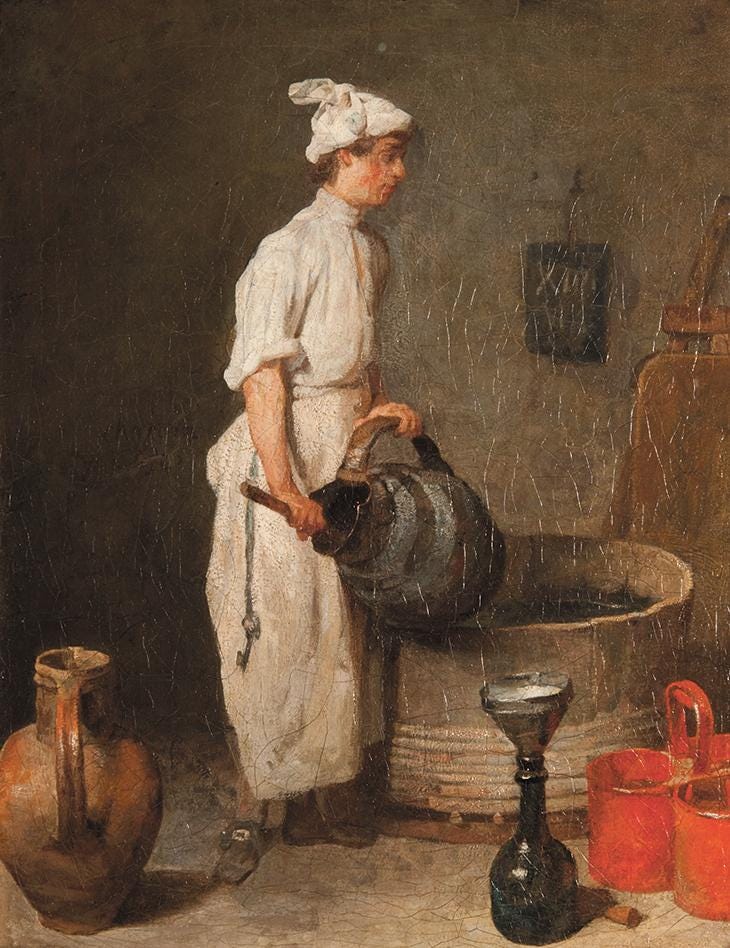
Jean-Siméon Chardin, The Cellar Boy, c. 1738. Oil on canvas. — a quiet servant boy paused in his work, holding a vessel as if listening to an inner light. Hunterian Art Gallery, University of Glasgow. Public domain. Image via Wikimedia Commons.
The painting is about a humble moment becoming sacred.
Here is a story-poem Inspired by Jean-Siméon Chardin’s The Cellar Boy, c. 1738. created by Angelic Assembly/Michele De Paris
The Cellar Boy
Track #1 style: baroque
Track #2 Style: French song
In the cellar, where the brown walls breathe,
and daylight enters softly,
a boy bends over a wooden tub
with a clay jug in his hands.
He was told,
“Wash this well,
scrub the dust,
rinse the mouth,
make it clean again.”
So he works.
The brush is small,
the jug is heavy,
the water dark and still.
Beside him,
a red bucket waits
like a little heart
glowing in the shadows.
His cap is white,
his sleeves are white,
and in that dim room
he seems almost like a candle
that has not yet learned
how bright it is.
Then suddenl,
he stops.
His hands remain on the jug,
but his eyes travel elsewhere.
Perhaps he hears footsteps above.
Perhaps someone is calling his name.
Perhaps the world outside
has opened a little golden door
inside his mind.
He sees fields.
He sees sunlight on stones.
He sees himself older,
walking beyond the cellar,
carrying not water,
but his own life.
And the jug,
silent in his hands,
becomes more than a jug.
It is a moon,
a bowl of memory,
a vessel waiting to be filled
with the sweetness of days.
The cellar boy does not speak.
But the painting speaks for him:
Even the smallest task
can hold a soul.
Even a servant child
can be full of kingdoms.
Even in the dark cellar,
light knows where to find
the humble heart.
Your songs always brighten my heart. Thank you.
I'll be thinking about this for sometime, brilliantly done! Thank you! Very inspired.